
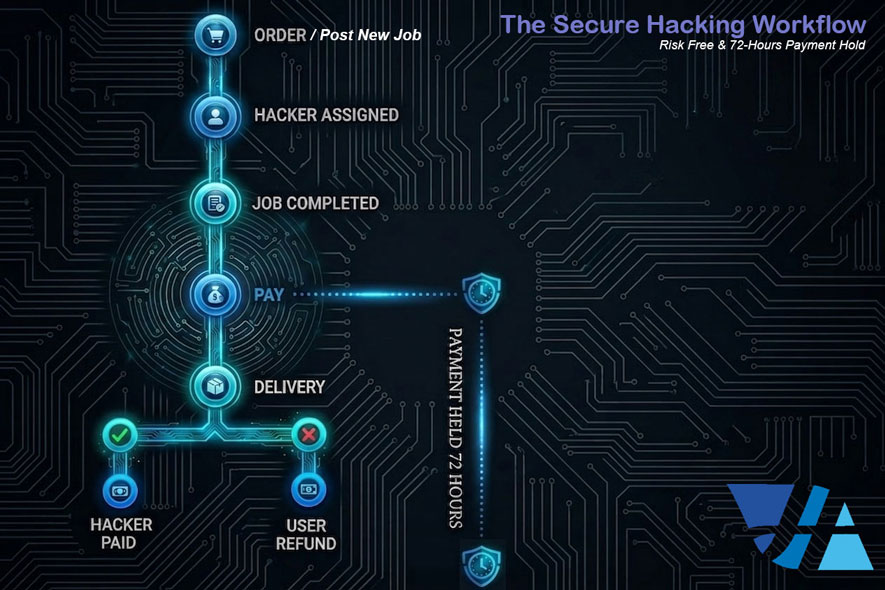
The digital landscape is a double-edged sword with the secure hacking workflow. While it offers unprecedented connectivity and innovation, it also presents complex security vulnerabilities that individuals and corporations struggle to navigate. Whether it is recovering a compromised corporate database, conducting a penetration test to find software flaws, or auditing digital assets, hiring specialized technical expertise is often necessary.
Why wait: Post new job
However, the peer-to-peer market for specialized cybersecurity and technical services has historically been plagued by asymmetry, mistrust, and outright fraud. Clients fear paying upfront only to be ghosted by a provider; technical specialists fear delivering flawless work only to have the client disappear without settling the invoice.
To bridge this trust gap, modern decentralized platforms have pioneered structured, transparent, and multi-layered transactional frameworks. By looking closely at industry-standard visual lifecycles—such as the operational flow used by modern technical brokerages—we can map out exactly how a secure hacking workflow, risk-free transaction occurs.
At the heart of this operational evolution is a combination of milestone tracking, verified execution, and a strict 72-hours escrow hold system. Let us dissect how this process works from start to finish, and why it completely eliminates the financial and operational risks traditionally associated with hiring specialized technical talent.
👮 The Traditional Dilemma:
The Trust Deficit in Technical Services
Before analyzing the mechanics of a secure hacking workflow, it is important to understand why the hiring process for independent cybersecurity professionals or technical experts has traditionally been fraught with danger.
In a standard digital transaction, two core risks exist:
- The Client’s Risk (Prepayment Fraud): The client pays an upfront retainer. The service provider, holding all the leverage, delivers subpar results or ceases communication entirely.
- The Provider’s Risk (Non-Payment): The specialist invests hours of high-level cognitive labor and complex computational power. Upon delivery, the client refuses to pay, leaving the specialist with no recourse.
Without a centralized, neutral mediator to enforce accountability, transactions descend into a standoff. This is where a structured, platform-mediated escrow the secure hacking workflow completely alters the paradigm. It shifts the dynamic from a game of blind trust to a system of objective verification.
👉 Related Post: The Psychology of Online Hacking: What Drives Cybercriminals?
📫︎ Phase-by-Phase Breakdown
of the Secure Hacking Workflow
A reliable technical engagement does not occur in a single, chaotic leap. Instead, it is broken down into a linear, traceable pipeline that protects both parties at every critical juncture.

1⃣ Order Initiation (The Blueprint)
Every successful project begins with clarity. In the Order phase, the client outlines the specific parameters of the project. This involves defining the scope of work, the specific objectives (e.g., retrieving lost data, locating system vulnerabilities, or configuring network architecture), and the agreed-upon financial compensation.
By formalizing these requirements on a secure hacking platform, an immutable record of expectations is established. This prevents “scope creep” later on and gives both parties a definitive benchmark for success.
2⃣ Specialist Matching (Hacker Assigned)
Once the project parameters are finalized, the platform matches the order with a vetted technical specialist whose skill set aligns precisely with the task at hand. In the Hacker Assigned phase, the project moves from an abstract request to an active workspace.
Because the platform acts as an intermediary, the specialist can begin working with the confidence that the project is legitimate, while the client rests assured that an appropriately skilled professional is handling their sensitive digital assets.
3⃣ Execution and Milestone Achievement (Job Completed)
During the execution phase, the assigned specialist carries out the technical operations required to meet the objectives. Upon navigating the technical challenges, the specialist marks the project as Job Completed.
Crucially, this does not mean money changes hands immediately. It signifies that the work is ready for comprehensive review and validation.
♙ The Core Defenses:
Strategic Payment & The 72 Hours Payment Hold
The true genius of a secure hacking platform transactional architecture lies in its financial mechanics, specifically the intersection of the Pay stage, Delivery, and the 72 Hours Payment Hold.
☟ [Order] ☞ [Hacker Assigned] ☞ [Job Completed] ☞ [Pay] ☞ [Delivery] ☞ [72 Hours Payment Hold] ☞ (Success/Refund)
🍮 How the Escrow Mechanism Protects Capital
In a secure hacking workflow, when a client hits the Pay milestone, funds are not deposited directly into the service provider’s personal wallet or bank account. Instead, the capital is routed into a secure, isolated escrow account managed by the platform.
This fundamentally alters the psychological dynamic of the transaction:
- 𝖆. The Specialist sees that the funds are fully secured and verified by the platform, proving the client has the financial liquidity and intent to pay.
- 𝖇. The Client retains ultimate leverage because the funds are held in suspension by a neutral third party until proof of work is provided.
۩ The 𝟟𝟚 Hours Holding Window:
Why it Matters?
Once the funds are secured in escrow, the project moves to the Delivery phase, where the specialist hands over the results, data, or reports to the client. This triggers an automated, mandatory 72 Hours Payment Hold.
This three-day window serves as an essential safety buffer for several reasons:
- ❶ Comprehensive Quality Assurance: Technical work cannot always be evaluated in five minutes. A script, database recovery, or system patch needs to be tested under real-world conditions. The 72 hours payment hold window gives the client ample time to verify that the deliverables function exactly as promised.
- ❷ Security Auditing: It ensures that the delivered assets are clean, secure, and free of unintended digital side-effects.
- ❸ Objective Arbitration Time: If there is a discrepancy between what was ordered and what was delivered, this window provides the necessary time to halt the transaction and initiate a review before any capital is permanently lost.
🏱︎ The Fork in the Road: Two Distinct Outcomes
At the conclusion of the delivery and review period, the secure hacking workflow splits into a binary path based entirely on objective verification. This ensures that no matter what happens, a unfair outcome is structurally impossible.
◆︎ Path 𝔸: Verification and Success (Hacker Paid)
If the deliverables meet the agreed-upon criteria established during the Order phase, the client approves the work (or the 72 hours payment hold window concludes without dispute). The escrow vault opens, and the Hacker Paid phase is triggered. The specialist receives their hard-earned compensation, the client receives their verified solution, and the transaction concludes successfully.
◆︎ Path 𝔹: Dispute Resolution and Capital Protection (User Refund)
If the specialist fails to deliver the promised results, provides incomplete work, or violates the scope of the project, the client can initiate a formal dispute within the 72 hours payment hold window.
The platform’s neutral arbitration team reviews the immutable project blueprint against the actual deliverables. If the specialist did not fulfill the contract, the escrow vault reverses the transaction, triggering a User Refund. The client’s capital is returned safely to their account, completely mitigating the risk of financial loss.
👌︎ The Benefits of a Standardized, Secure Hacking Workflow
| 🎀 Benefit | 🎅 For the Client | 🐋 For the Technical Specialist |
| ① Financial Security | Eliminates upfront fraud; capital is protected by escrow until satisfaction is achieved. | Guarantees that funds are secured before labor begins, eliminating non-payment risks. |
| ② Operational Clarity | Establishes a rigid, milestone-based timeline with clear delivery expectations. | Provides a definitive, unchanging project scope, preventing unpaid work extensions. |
| ③ Risk Mitigation | The 72 hours payment hold window allows for real-world testing and validation of technical assets. | Protects professional reputation by utilizing an objective platform review system. |
| ④ Peace of Mind | Access to vetted professionals backed by a comprehensive refund policy. | Ability to focus entirely on high-level problem solving without worrying about collection. |
👍︎ Conclusion: Emphasizing Safety in Digital Transactions
The digital age demands specialized solutions, but it should not require individuals or businesses to gamble with their hard-earned capital. Relying on unverified, unstructured agreements in the digital underground or independent freelancing spaces is a recipe for financial disaster.
By channelizing projects through a structured workflow—governed by clear milestones, milestone-locked escrow accounts, and an unyielding 72 hours payment hold validation — platforms like Hackerslist Marketplace have successfully de-risked specialized technical engagements. This framework ensures that honesty is rewarded, malicious actors are neutralized, and technical expertise can be acquired with absolute financial peace of mind. When entering complex digital landscapes, never settle for blind trust—always insist on a secure hacking platform, escrow-backed on the secure hacking workflow.
